


NO MAN IN THIS WAR HAS SO WELL TOLD THE STORY OF THE AMERICAN FIGHTING MAN AS THE AMERICAN FIGHTING MAN WANTED IT TOLD.
~President Harry S. Truman, Statement on the Death of Ernie Pyle.
As a Pulitzer Prize-winning American journalist and war correspondent, Ernie Pyle told powerful stories about everyday American G.I.s. Ernie’s mission was to portray war from their eyes. His reputation as a friend to soldiers was well-earned, and millions of readers relied upon him for information and news. He introduced the concept of camaraderie between service members by sharing the harsh realities of war with his readers. Pyle’s columns were published in approximately 400 daily and 300 weekly newspapers during his prime. Although he wrote about the military in general, Pyle particularly praised the infantryman. He respected the bravery and firmness of the foot soldiers and once stated that they were indispensable in winning wars.
In 1940, Pyle embarked on a journey that redefined wartime reporting. His first stop was England, where he immersed himself in the heart of the Battle of Britain. In the following three years, Pyle traveled extensively through North Africa, Italy, and France, covering battles from Anzio to the beaches of Normandy on D-Day to Okinawa in the Pacific, bringing the Battlefront and stories of the American G.I.s to the home front.

There was nothing typical about Pyle as an embedded war correspondent in the military units. The Army placed a few restrictions on him, as he was given full access to all facets of military life, including members of the infantry, artillery, tank crews, doctors, nurses, and many others. He didn’t just visit these units; he became a member and stayed close to the front line.
While living alongside the men, he welcomed the opportunity to share and document their brotherhood, losses, and wins. He became accustomed to weeks without bathing and shaving. He washed his feet in a steel helmet and rested his head on the unforgiving ground. In 1944, he suggested that soldiers receive “combat pay” like airmen receive “flight pay.” This led Congress to enact a law creating “The Ernie Pyle Bill” that provided combat infantry with an additional $5 to $10 a month.The U.S. Army also adopted Pyle’s suggestion of providing overseas service bars on uniforms to designate six months of overseas service Despite the chaos of war, he was passionate about documenting the G.I.s’ lives. He weaved those experiences into a narrative of unparalleled war coverage through a simple storytelling style and first-person narratives, which made him popular with readers worldwide.
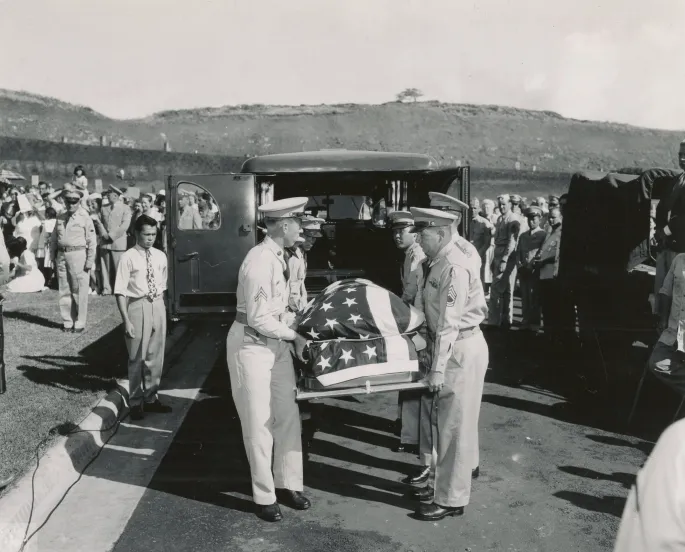
He covered several military campaigns in Europe but returned home due to combat stress. However, he was later asked to cover the Asian-Pacific Theater and grudgingly agreed. Ernie Pyle, 44 years old, died on April 18, 1945, after being struck by a Japanese machine gunner’s bullet on Ie Shima, a small island near Okinawa in the South Pacific.
“War makes strange giant creatures out of us little routine men who inhabit the earth.” ~ Ernie Pyle
He won the Pulitzer Prize in journalism in 1944, and his columns were collected into books, one of which became the basis for the movie The Story of G.I. Joe (1945).He was featured on the cover of Time magazine, July 17, 1944. In 2018, August 3rd is designated Ernie Pyle Day!
Lee G. Miller is the author of The Story of Ernie Pyle.
Sources:
● Harry S. Truman, Statement by the President on the Death of Ernie Pyle
● War Correspondent/Journalist – Ernie Pyle
● Famous Hoosier, Ernie Pyle
● Designating August 3, 2018, as “National Ernie Pyle Day”
● Ernie Pyle World War II Museum
● Reporting America at War
● Congressional Record-House H4365