

Group of Signal Corps Telephone Women (‘Hello Girls’) back in the United States after active duty in France. 1919. NARA No. 45567985.

In November 1917, amidst the chaos of World War I, the Allies found themselves entangled in a web of telephone lines. American Expeditionary Forces (AEF) Commander John J. Pershing had set up the U.S. Signal Corps to wire the telephone lines from the frontlines back to the Allied Headquarters. The Signal Corps men laid down the lines but began to struggle with the influx of calls in their operating room. At the same time, American, British and French soldiers at the frontlines desperately needed the telephone operators’ support, as they were frequently calling in artillery and updating changes on the battlefield.

After advertising the need for women telephone operators in the Western Front, 1,750 American women applied for the opportunity. 450 women were allowed into the training process, but only 223 were qualified to serve after passing the rigorous requirements. Grace Banker, the Chief Operator of the U.S. Signal Corps Unit in World War I said, “The girls had to speak both French and English and they also had to understand American Doughboy French.”On top of the bilingual skills, the women had to be able to decipher through hundreds of codenames that changed daily. The women who passed the requirements and joined the U.S. Signal Corps embarked on a journey that would ultimately serve the men on the frontlines as well as the women back home.
In March 1918, the Signal Corps Female Telephone Operators Unit, led by Grace Banker, undertook a transatlantic journey to install telephone switchboards, complete with power connections. Their operations spanned across Paris, Chaumont, and seventy-five other locations in France, as well as various British sites in Winchester, London, and Southampton. Once the telephones were connected, the women began answering calls right away.
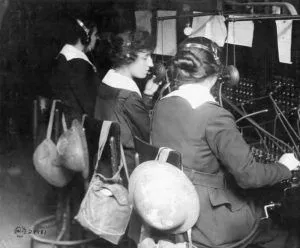
The American and French soldiers on the Western front soon heard hundreds of women answering their calls for artillery support as they started the battle for the French town of Saint-Mihiel in September 1918. Later supporting the Doughboys on the Meuse-Argonne Offensive, the Signal Corps women were nicknamed the ‘Hello Girls’. The ‘Hello Girls’ did not just answer artillery support orders, they also delivered orders for soldiers to advance or retreat and informed pilots of when they were supposed to take off to support the battle.
Even though they were miles away from the battlefields of World War I, the ‘Hello Girls’ had to deal with artillery attacks and frequent fires during their 12 hour shifts. In one instance, the telephone operating room caught fire. The women ignored the calls to evacuate the building in order to continue serving the men on the frontline. They only left their post after an Officer threatened to court-martial them. Once the fires were extinguished, they went right back to answering calls. The women were constantly exposed to the horrors of warfare. According to Texas A&M Professor Elizabeth Cobbs, “The work was dangerous and exhausting, with switchboards set up in shacks that drew German artillery fire. The ‘Hello Girls’ worked with little sleep amid constant bombardment, helmets and gas masks flung over their seats, just in case.” Even with these conditions though, the ‘Hello Girls’ would answer an astounding 26 million calls by the end of the war in November 1918.
The dedication and discipline the ‘Hello Girls’ showcased in World War I impacted American citizens to the point that the culture shifted. President Woodrow Wilson, influenced by the stories of the women serving their countries, pushed for the United States Senate to pass an amendment providing women with the right to vote. In 1920, the 19th Amendment was ratified, delivering voting rights to American women and completing one of the main missions of the women’s suffrage movement of the era.
Even though they would make a huge cultural impact back home for their military service, the United States Army viewed the ‘Hello Girls’ as civilian employees and refused to provide them with veteran benefits after the war. It took 60 years and 50 petitions until the United States government would grant them a veteran status. President Jimmy Carter signed the GI Bill of Improvement act of 1977, which categorized the ‘Hello Girls’ as veterans and earned them the Victory Medal of World War I. Two years later in 1979, the 31 surviving women received the medals.

Through all the hardships with telephone operating in the war and military benefits back home, the ‘Hello Girls’ stood the test of time through their service and have become a story of triumph and hope in the midst of the carnage of World War I. The ‘Hello Girls’ contribution is remembered today through books and plays such as Elizebeth Cobb’s The Hello Girls: America’s First Women Soldiers book and Prospect Theatre’s ‘The Hello Girls’ 2018 Broadway Musical.
Sources